

Mile Zero — Antarctica 1985.
True Torque done here.

Awaiting the storm. Ross Sea, Antarctica. Eight months at sea. Whaling. It's me on ship deck.
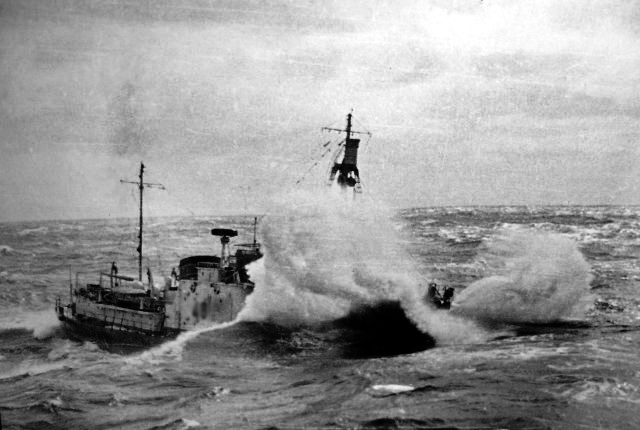
This party’s just getting started.
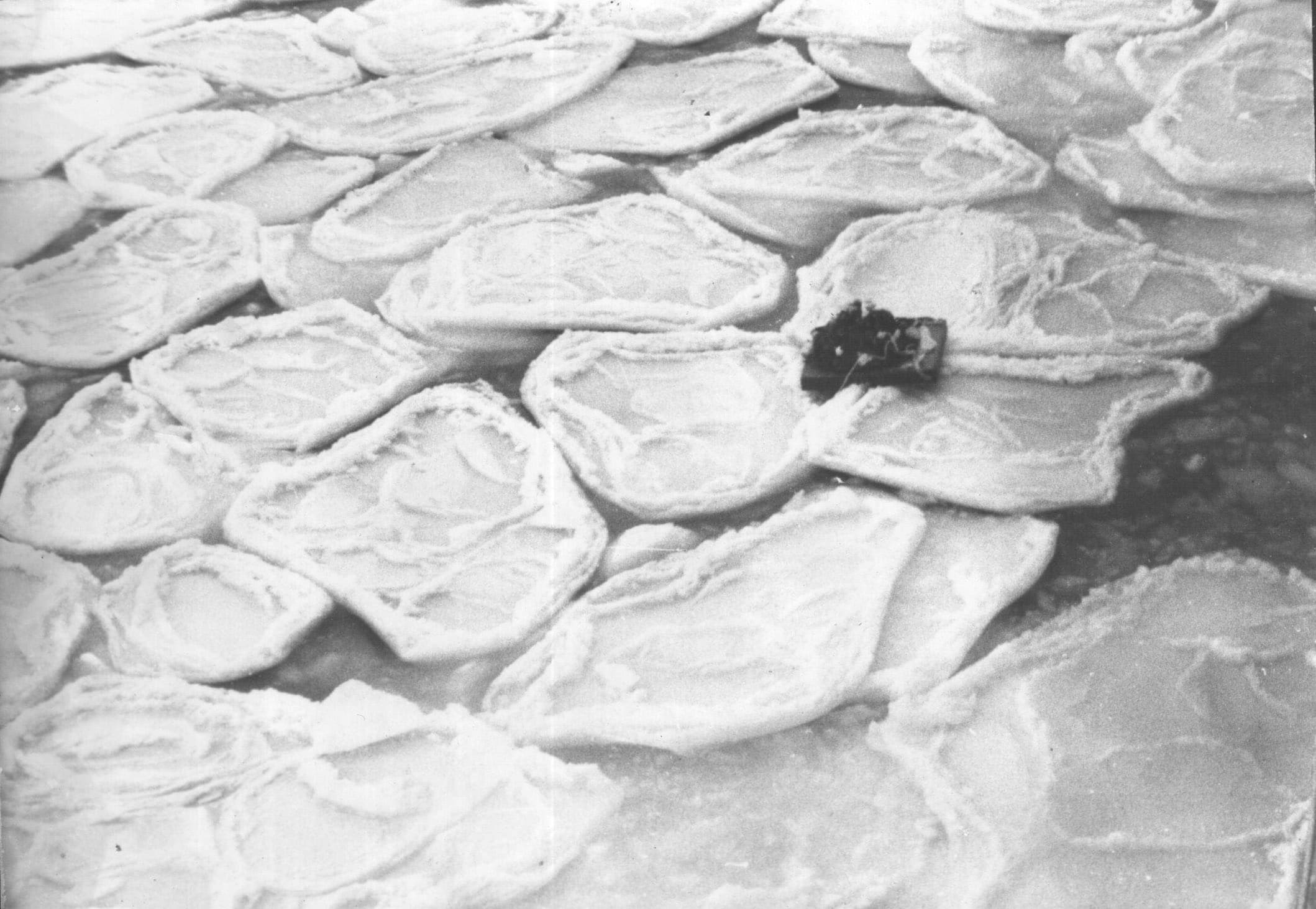
Wreath for the ones who kept eternal watch in the ice.
In it, the anchor stock became the crossbar of the Cross.
God looked. Said nothing. Enough.
Out there, at the edge of the map, something starts to happen to you. You stare at the ocean so long it starts staring back. Your mind answers something like: I am → i am → i AM — a damn good way to go crazy, if the sea ever gave you any time to begin with.
Some professor N., a scholar of ancient Greek philosophy, would probably call it the emergence of the apeironic consciousness — the kind unbound by the frame of “I” (from Greek apeiria, boundlessness). I would add that this thing also makes you physically strong like a draft horse. A couple of years whaling in the Antarctic, on a rust-bucket hull without ice rating, grants me the right to say so.
Where the hell does that force even come from? Answer that and you’ll know what those seamen actually were — the ones left only in photographs. Let’s get to it.
Imagine a ship’s deck in a storm. The deck heaves. Now imagine a spring — built to compress and release. In a storm, the deck drives your body into the same mechanical work a spring performs.
Through that spring, you connect your entire I-am — your “I exist” — to the infinite kinetic energy of the waves. You physically absorb and return that energy in real time. It’s like taking your foot off the clutch between your body and the ocean and slamming the accelerator to the floor. Storm-grade torque starts roaring through you. An incomprehensible amount of Joules — I am a sailor — God mode.
Wrench drop:
Your I-am has torque — I-amQ.
I-amQ Garage. Forty years on.
92,000 fucking Joules. I checked the math for the third time and realized I needed a cup of coffee…
Once, I sold my soul to a 16th-century biohacker — Don Jerónimo de Carranza, the founder of the Spanish fencing school known as La Destreza. Don Jerónimo hacked the human being and realized that God built us as a musical instrument. His students tuned their I-am as if it were a Steinway piano, and thrust their rapiers forward with the serene composure of Frédéric Chopin playing his Nocturne in E-flat major No. 2.
The idea of the human as a musical instrument short-circuited my mind, too well-behaved by anatomy atlases and biomechanics. Alas, that idea is four centuries too late. It’s uneasy in our world, where the electric scooter has become the archetype of the office Zoomer, and biohacking has devolved into just a technique for charging your small, internal battery.
Yet, 92,000 Joules...
The math shows that a baseline 70-kilogram office Zoomer body can absorb and release an incredible 92,000 Joules of elastic energy in minutes. Not at sea. Not in a storm. Anywhere — even the office cubicle.
That’s over four times the capacity of a 70-kilogram spring made of hardened steel.
To put that in perspective: 92,000 Joules could launch a 291-kilogram steel-constructed Zoomer onto the roof of a 10-story building — straight into a superhero comic plot.
Wrench drop:
By God's own Spec Sheet for His product, Human, you possess immense elastic energy capacity. Even if you don't know it.
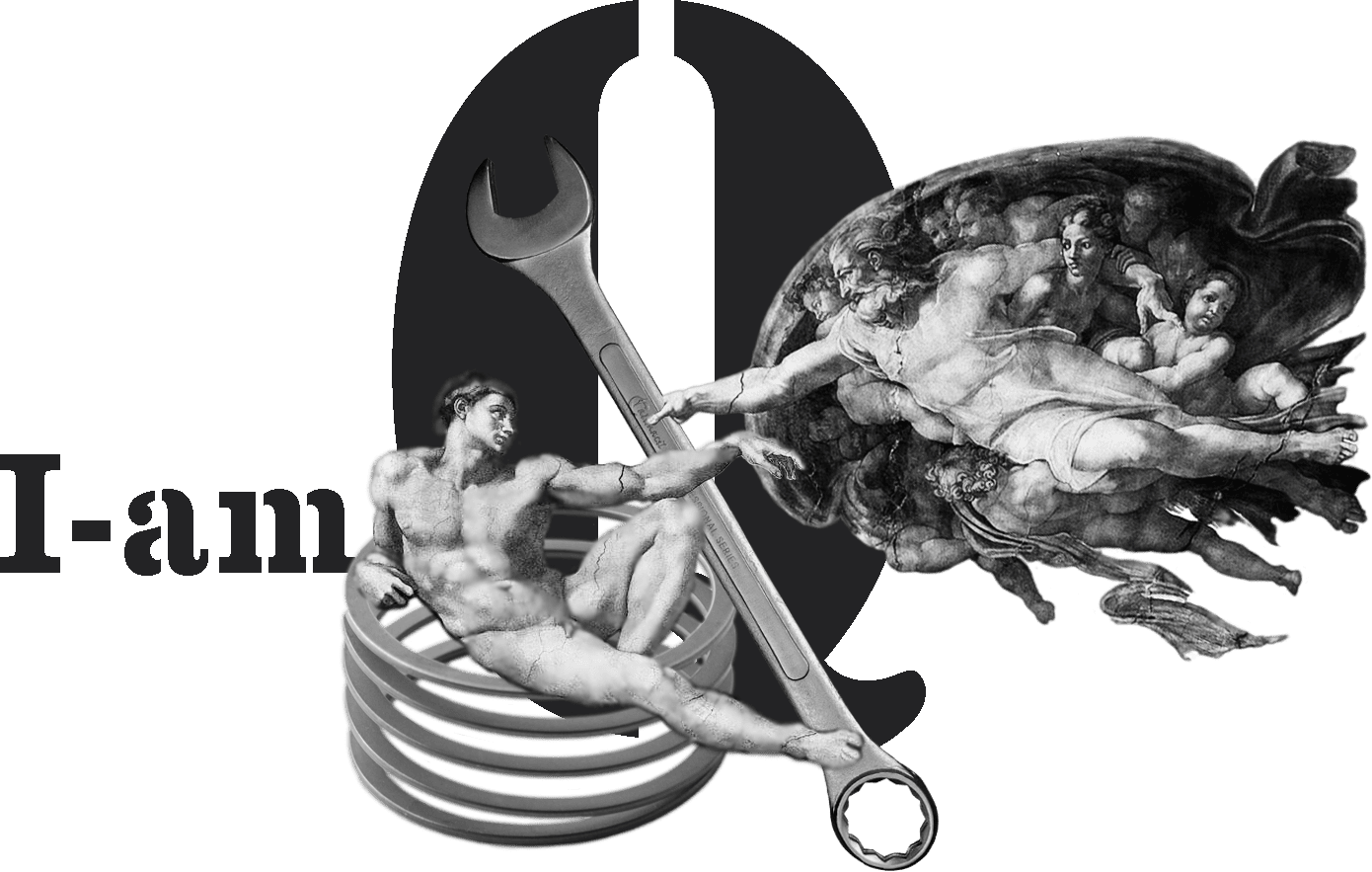
God — The Master Engineer
Human Spec Sheet
§1. Springy Human
From an engineering standpoint, the human being is a biomechanical spring constructed of bone, muscle, and fascia, engineered according to Newton's laws to interface with Earth's gravity.
This spring doesn't fight Earth's gravity. It draws Joules of its own elastic energy from it and invests them back into the kinetic energy of our movements.
Can we expect the same mechanism from our psyche? Yes.
Earth's gravity supplies our psyche with the planet's Ground Zero — the anchor point against which we calibrate our relationship with the world.
We are constantly — emotionally and mentally — searching for this gravitational anchor.
It’s this search that generates the self-evident, intuitive language by which we structure our social experience: to be grounded, to be on shaky ground.
Subconsciously, we perceive the world as a gravitational force field where people and ideas possess "mass" and "attraction." We make decisions by "weighing" the pros and cons.
Crucially, our psyche, just like the body, is inherently engineered for powerful rhythmic compression and decompression. It compresses under the pressure of challenges, stress, and responsibility. It then discharges with insights, decisions, and action.
The accumulated elastic tension multiplies the psyche’s kinetic energy: the deeper the compression, the more powerful the resulting decisions and action.
Wrench drop:
God didn’t waste time on the creativity. He calibrated our body and psyche using the exact same physics: the spring and Earth's gravity.
§2. Human I-am.
Neuroscience states that our spring connection to Earth's gravity — and thus to the world — is executed in the brain via a neural program. This program is designated IMG (Internal Model of Gravity).
The IMG functions as an API — a system of gravitational rules and protocols governing our presence in the world. Essentially, it is the low-level code that provides the clutch between our body and psyche and Earth's gravity — and therefore, the torque.
(Imagine your engine has a poor clutch-to-wheel connection, and the wheels have poor traction with the road. I'd bet that no matter your IQ — with metrics like that — you won't be driving far.)
The IMG continuously runs within us on a neuroprocessor assembled from the neural networks of the brainstem's vestibular nuclei, the cerebellum, the thalamus, and the brain's posterior insula.
We sense the silent operational hum of this IMG-loaded neuroprocessor as our I-am.
The computational power of this I-am neuroprocessor is immense. Here is the discouraging data point:
Our mind (localized in the prefrontal cortex) — with all its knowledge, thoughts, social skills, future plans, and IQ — has 132 times less computational capacity at its disposal.
That’s a difference of 13,100%.
Wrench drop:
Earth's gravity is fundamentally hardwired into us, at the processor and code level. It transforms our I-am from a Liability into an Asset.
To be clear:
I am describing our brain's function in terms of a computer processor and code. This is a conscious engineering move. My objective: to deliver you to the tools for a 4-Wheel Drive Life.
I could ramble about the neurophysiology of the brain along the way. But I'll answer like the taxi driver in the old joke: "Talk or drive, buddy? I'm not a tour guide."
Nevertheless, keep in mind that the striking functional similarity between the human brain and a computer does not negate the equally striking differences in their computational logic and hardware. Therefore, I wouldn't advise you to use this text as a cheat sheet in a Stanford bioengineering exam.
§3. IMG: Audit and Upgrade
The IMG (Internal Model of Gravity) is a powerful neural I-am program. The problem is that the office lifestyle — with its restricted motor activity and sedentary postures — truncates its functionality.
It’s like being promised powerful software but receiving only a free demo version:
- Half the functions are disabled;
- Bugs crash you out of the program.
Running this "office" version of IMG, the brain's I-am neuroprocessor performs like an old laptop freezing on Excel spreadsheets.
The body's spring poorly interfaces with Earth’s gravity, ceasing its rhythmic compression and decompression and losing the ability to store energy. You compensate for the lost elastic recoil by generating muscle tension.
Instead of investing the Joules of Earth’s gravity into every step, you spend your own "cash" — raw muscular effort. Your biomechanics become costly, and your movements become stiff and heavy.
Errors accumulate in the code of the "office" IMG version:
Any physical load, instead of being distributed across the entire spring construct, hits specific segments — the knees, low back, and neck.
It’s as if some of the spring's coils have seized.
The psyche stops "springing" as well. It becomes rigid, stuck between chronic compression and a lack of discharge.
Apathy replacing insights and powerful decisions? That is the loss of elastic recoil in response to stress.
Lost confidence in your own capability? It didn't leave alone; it left with your sense of anchor — Ground Zero Earth's gravity.
Yes, the IMG continues to run. But it only supports your I-am barely, on the crutches of compensation.
Your I-am Torque — your I-amQ — plummets like the Dow Jones index on Black Monday.
I would argue that such an IMG configuration literally begs for an I-amQ audit and upgrade. If, of course, you see value in your own Torque and the spring of your body and psyche.
Wrench drop:
Your wear and tear is not a hardware problem. It's a software problem.
But there’s one more thing — the Ace of Trumps: the clock speed of the I-am neuroprocessor, and thus, its performance.
§4. I-am: Ace of Trumps
(It’s gonna be a long read, but I promise it’s worth it.)
§4 drags us to South Africa. To an office party in Durban’s Black township of KwaMashu, where the stones still hold the pressure of apartheid. A holiday for a company that trades in used electric generators — why not? It is good business in a place where “living like a lord” simply means having electricity in the socket. A typical party in the office parking lot. The gasoline drifting in from nearby repair shops mixes with the smoke from the barbecue.
Here’s Nomsa, the admin. She aches for a life with no wailing police sirens and sidewalks stacked with trash. Here’s Sipho, the mechanic, sporting a scar from a street brawl. He once dreamed of kicking goals on a football pitch, but this is KwaMashu. And here’s Thabo, fifty, an accountant who feels like life’s grown tired of waiting while he counts everyone else’s money.
The afro-pop bass shakes the speakers. Thabo, the accountant, awkwardly stands up and… No way! — he unleashes a high kick. Thabo’s shadow under the streetlight dances a mad can-can, like some old Broadway musical back when TVs were still black-and-white. It almost looks like he’s trying to kick his slipping glasses back onto his nose.

You can catch a can-can like this in any Black township across KwaZulu-Natal, where Zulu from rural communities migrate in search of work. In these rough urban spaces, where personal scars are just the fine print of a collective tragic history, a can-can with high kicks and stomps becomes a tool for Zulu to Self-Fix their I-am. It shakes off the homesickness for community roots, the “I am nobody” slump, and cranks their I-am back into the red.
This is what the 92,000 Joules are for.
The Zulu can-can is a powerful spring movement with explosive accelerations against Earth's gravity and rhythmic strikes into the ground that unblock the clock multiplier of the brain's clock generator, the RAS (Reticular Activating System).
Functionally, the RAS differs from a computer clock generator only in that, instead of binary code, it raises and lowers brain frequencies using neurotransmitters: norepinephrine, acetylcholine, dopamine, and serotonin.
The RAS multiplier contains no instructions or logic. It is simply a floating coefficient that is set in the electrochemical code of the brainstem's Reticular Formation.
The RAS accelerates the I-am neuroprocessor, which is assembled from the neural networks of the brainstem's vestibular nuclei, the cerebellum, the thalamus, and the posterior insula:
ƒout = ƒbase х G(RAS)
Where:
- ƒout — the output frequency of the I-am neuroprocessor,
- ƒbase — its base frequency,
- G(RAS) — the gain coefficient (multiplier number).
In the language of neuroscience, this is called: multiplicative modulation. The unlocked multiplier delivers exponential growth in the computational power of the I-am neuroprocessor.
The result: a boost to I-amQ — the Torque of the body and psyche.
Wrench drop:
I-amQ — your Torque — has a multiplier.
Conclusion cancelled.
If you made it this far — the easy part of the road is over.
Clearly, the spring of our body and psyche, rated for 92,000 joules of relationship with Earth’s gravity, is redundant for the average I-am.
The average I-am simply has no scenarios that call for it.
Which leaves only one explanation for those 92,000 joules: Earth’s gravity is something more than we usually think it is.
Not that this should be surprising — it’s hard to cram into the mind something the mind fundamentally lacks the computational power to process (see §2).
Earth's gravity speaks to us in a chthonic (from the Ancient Greek word — chthon, or the primordial forces of the earth) language of the brainstem, cerebellum, thalamus, and insula.
That’s why in the I-amQ Garage, torque isn’t built through ordinary physical exercise. Garage Torque Building includes Spring Re-Bolt and Stomp tools — more akin to the rhythmic strikes into the sand from the epic "Dune," which Paul Atreides called the colossal sandworm on Arrakis.
Biomechanics calls this Ground Reaction Force. The Earth (Newton's 3rd Law) reacts to your stomp. You crank a spring resonance with Earth's gravity, and the G(RAS) multiplier accelerates its incredible Torque within you.
The result is 4-wheel Drive Life. It's like switching from a Toyota Prius to a Jeep Wrangler Rubicon.
No matter what happens, you put the pedal to the metal. Onward and Upward.
You steer out of the toughest life situations. You build the road where others are high-centered and stuck. You force the hill. You possess high I-amQ — Torque.
This doesn't mean that a moderate I-amQ has no advantages.
If your philosophy is stability and rest straight out of a tourist brochure, then building a reliable, well-tuned I-am with moderate Torque is a perfectly valid choice. It’s built for the daily commute and the weekly routine. Just don’t speed, don’t bend the rules, stay in your lane, and everything stays okay.
The only drawback: you simply don’t have the horsepower for fucking crazy ambitions.
That’s the pragmatic, engineering approach of the I-amQ Garage.
High I-amQ delivers insane Torque on the "wheels," necessary for 4-wheel Drive Life. Moderate I-amQ means less "horsepower," but a comfortable ride on a flat road. Low I-amQ signals you have a problem.
The Edge:
Earth's gravity has another Ace up its sleeve. You can run all the executive check-ups at the Mayo Clinic you want, track every biomarker down to the last micronutrient, and load up on nutraceuticals. The ROI on that remains questionable. Because the primary functional biomarker of aging is the mechanical-gravitational deficit that accumulates in your mitochondria, blood vessels, muscle fibers, and brain’s neural networks. It’s the same physiological failure mode we see in astronauts after prolonged exposure to an Earth-gravity deficit on the ISS — accelerated aging kicked into fast-forward.
This age problem is solved in the I-amQ Garage with tools engineered from the very same Newton's 3rd Law.
Age → Mileage. Garage engineering
I-amQ Garage — torque and age, wrenched here.
Pull in → Subscribe.